
Before diving into the mechanics of compliance debt, it helps to understand the landscape of cookie consent compliance. Cookies are small data files used for analytics, personalisation and advertising. Laws like the GDPR require websites to obtain clear consent before placing non‑essential cookies to give users real choices.
When organisations delay fixing their cookie banners or policies, they not only break the rules but also signal that user privacy is an afterthought. In this article, we discuss why cookie consent matters, what happens when companies keep postponing fixes and how they can get back on track.
What is compliance debt?
Software teams speak of technical debt when shortcuts taken today lead to bigger problems tomorrow. A similar concept applies in the compliance world.
Compliance debt arises when a company fails to keep up with evolving legal requirements and leaves privacy, security or regulatory gaps unaddressed.
Examples include collecting personal data without a lawful basis, failing to publish an updated privacy policy, and, notably, ignoring cookie consent requirements.
Cookie consent is an area where compliance debt accumulates rapidly. Many websites still use banners that pre‑select consent, bury the refuse option, or set tracking cookies before obtaining any permission.
Here are some major cookie consent requirements:
- The ePrivacy Directive and GDPR require explicit, freely given consent before placing non‑essential cookies.
- US laws such as the California Consumer Privacy Act (CCPA) require transparency and opt‑out options for data sharing.
At first, these shortcomings may not be obvious. They accumulate quietly until a regulator, business partner, or customer flags them. By then, they may be deeply embedded in systems and business practices, making them costly and time‑consuming to fix.
Key privacy laws you must know to avoid compliance debt
Cookie consent requirements are not confined to one jurisdiction. As a result, websites that collect or process personal data via cookies must comply with multiple privacy laws, depending on the locations of their users.
While the details vary, a common principle runs through most frameworks: non-essential cookies require user choice and control.
GDPR (European Union)
The GDPR requires websites to obtain explicit, opt-in consent before placing non-essential cookies such as analytics, advertising, or tracking cookies.

Consent must be freely given, specific, informed, and unambiguous. In practice, this means cookies cannot be set until the user takes a clear affirmative action.
They must also be able to refuse cookies as easily as they accept them, and consent must be withdrawable at any time without friction.
ePrivacy Directive (EU Cookie Law)
The ePrivacy Directive works alongside the GDPR and specifically governs the use of cookies and similar technologies. It reinforces the requirement to provide clear information about cookies and to obtain prior consent for any cookies that are not strictly necessary for the website to function.
Many cookie banner enforcement actions in the European Union are grounded in violations of this directive.
CCPA (California)
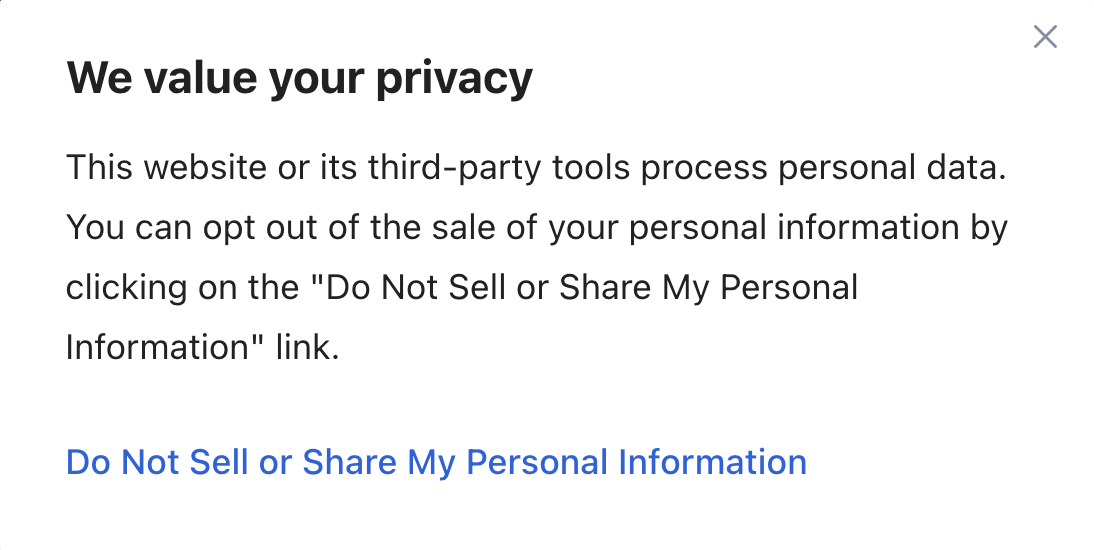
California Consumer Privacy Act take a different structural approach. Instead of requiring opt-in consent in all cases, they generally follow an opt-out model.
This means businesses must give consumers a clear and accessible way to opt out of the sale or sharing of personal information, typically through a “Do Not Sell or Share My Personal Information” link.
However, opt-in consent is mandatory for certain categories of data subjects, such as minors.
Other global privacy laws
Outside the EU and the US, cookie and tracking obligations are expanding rapidly. India’s Digital Personal Data Protection Act, Canada’s PIPEDA, and the UK’s PECR and UK GDPR all impose transparency, consent, and user-rights requirements that affect how cookies and tracking technologies are deployed.
While enforcement styles differ, regulators increasingly expect websites to offer meaningful choice, limit data collection to what is necessary, and respect user preferences across sessions and devices.
Cookie consent has outgrown being a mere regional issue. Now, for businesses with global audiences, treating cookie compliance as a one-time checkbox creates ongoing regulatory risk and contributes directly to compliance debt.
Read
Compliance debt: What are the consequences of delaying cookie consent fixes?
The following are the most common consequences of delaying cookie consent on websites:
#1 Regulatory penalties
The most visible consequence of cookie non‑compliance is regulatory enforcement. Data protection authorities (DPAs) across Europe and state attorneys general in the United States have imposed significant penalties on businesses that delay cookie fixes.
Examples include:
- In 2022, the French DPA (CNIL) fined Google with $150 Million for using dark patterns in cookie consent.
- In May 2025, California CPPA fined clothing retailer Todd Snyder, Inc. $345,178 for failing to process opt-out requests and not honouring UOOM signals.
- Chinese Authority flagged 68 mobile apps and removed 22 apps after repeated violations, citing missing or inaccessible privacy policies, implicit consent, and no easy way to withdraw consent or refuse targeted advertising.
These enforcement actions show that regulators look for fairness (equal prominence of accept and refuse buttons), transparency (clear explanations of what cookies do) and respect for user decisions.
#2 Legal actions and operational headaches
Administrative penalties are only part of the picture. Individuals or consumer groups may sue companies for failing to respect privacy preferences, and class‑action litigation can arise in multiple jurisdictions.
Investigations, audits and legal proceedings consume staff time and distract from core business. In some cases, payment processors or business partners may suspend services until issues are resolved, cutting off revenue and straining cash flow.
#3 Erosion of trust
Privacy is increasingly a factor in consumer loyalty. When users see banners that nudge them toward acceptance or find that a site continues to track them despite their choice, they may lose faith in the brand.
A CISCO study revealed that 95% of people will stop buying from companies they do not trust with their data.
A damaged reputation is hard to repair and can lead to higher bounce rates, lower conversion and negative press coverage.
#4 Lost opportunities
Putting off cookie compliance can affect the bottom line in less direct ways. Corporate clients often run privacy assessments when selecting vendors, and a non-compliant cookie banner can derail an otherwise promising deal.
At the same time, most analytics and advertising platforms, such as Microsoft Clarity, Google Analytics, and Google Ads, now strictly enforce cookie consent requirements. Teams that rely on unconsented tracking will increasingly find gaps in reports, missing conversion data, and limited audience insights.
To address this, platforms require websites to implement consent mode, a framework that allows tools to adjust their behaviour based on a user’s consent choices.
When consent is denied, tracking does not stop entirely but shifts to privacy-preserving signals and aggregated measurement. Without a consent mode properly configured, analytics and ad platforms may stop collecting data altogether, reducing the effectiveness of marketing campaigns and performance reporting.
Common mistakes that build cookie compliance debt
Here are some of the most common cookie compliance mistakes on websites:
Hidden or unequal choice
Some banners present a large, colourful Accept button but hide Reject in a text link or secondary menu. Such designs are seen as dark patterns and often lead to fines.
Pre‑checked consent boxes
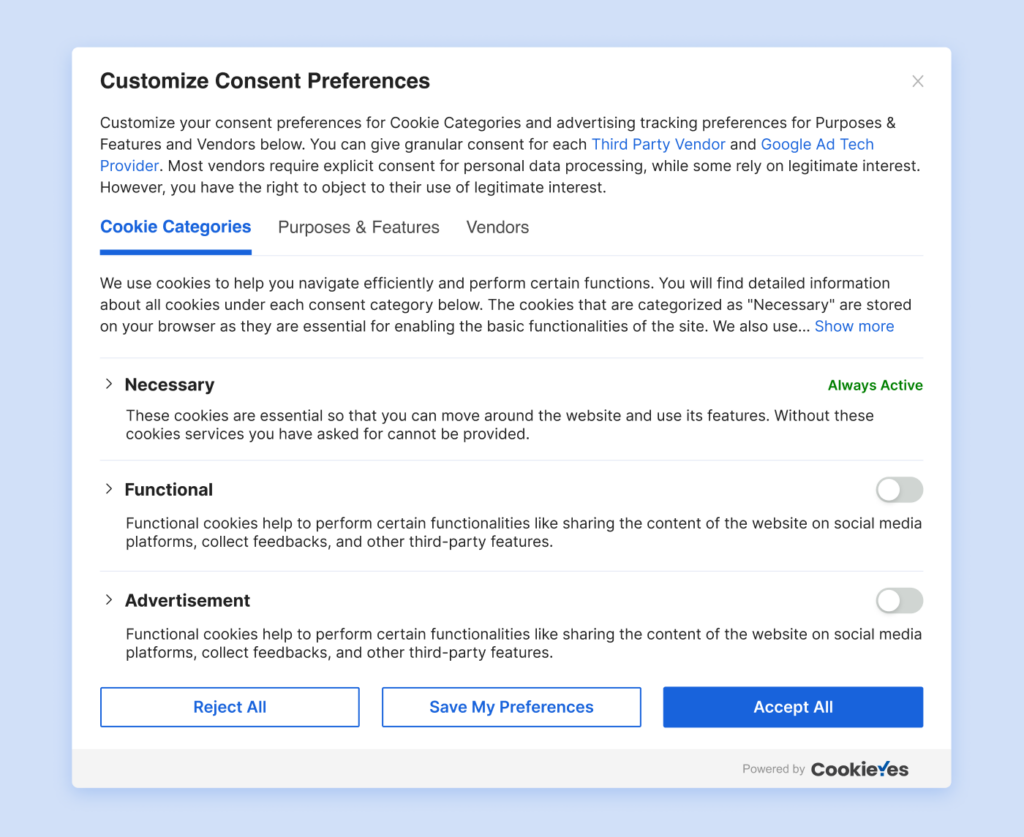
A user’s silence or inaction is not consent. In the European Union or similar opt-in jurisdictions, checkboxes or sliders should be off by default so that visitors actively choose to enable non‑essential cookies.
Missing cookie banner
Under opt-in laws, websites that set non-necessary cookies, including third-party cookies, before asking for permission risk enforcement, even if they list cookies elsewhere on the site.

Create a compliant cookie banner easily
Sign up to CookieYes for a user-friendly consent management experience
Try for free14-day free trialCancel anytime
Vague or incomplete explanations
People need to understand why cookies are being used. Simply listing vendors without describing purposes. Categorise the cookies and also name individual cookies, who places them, duration, etc, to help users make granular cookie choices.
Also, provide a cookie policy describing the use of cookies on your website and link it from the banner.
Lack of granularity
Banners that lump all cookies together leave users with an all‑or‑nothing choice. Offering separate categories, such as functional, statistical and marketing, respects user autonomy. This is often given as a second layer in the cookie banner for a layered approach.
Relying on legitimate interest for marketing cookies
Some organisations invoke legitimate interest to avoid asking for consent. Regulators have repeatedly indicated that this basis does not apply to cookies used for tracking and profiling.
Outdated banners and policies
As technology and laws evolve, consent mechanisms must be reviewed and updated. New third‑party tools may introduce tracking that old banners do not cover. Regular cookie audits help keep documentation current.
Why compliance debts are especially risky now
Privacy enforcement is increasing around the world. New laws in multiple jurisdictions expand the rights of individuals to control how their data is collected and used.
Supervisory authorities are coordinating investigations and sharing information. Consented data is more valuable now than ever. Companies that ignore these trends risk falling behind and scrambling to retrofit compliance under pressure.
Clearing the backlog: getting out of cookie compliance debt
Addressing compliance debt requires a structured approach:
- Audit your website: Identify every cookie and similar technology in use, whether first‑party or third‑party, and determine whether each is essential or optional.
- Consent: Ensure that you obtain opt-in or opt-out consent based on regional privacy laws.
- Design a compliant cookie banner: Provide equally prominent options to accept or refuse optional cookies. Avoid pre-checked boxes or toggles.
- Offer granular settings: For opt-in banners, let users decide which types of cookies to allow. Consider separate toggles for preferences, analytics and marketing.
- Use plain, accessible language: Ensure that your cookie message is in simple language. Avoid legal jargon so that everyone can make informed decisions.
- Keep preferences easy to find: Add a link to Privacy preferences in the footer so users can change their choices at any time. The cookie widget is also a commonly used option.
- Maintain consent records: Keep a log of when and how users granted or withdrew consent.
- Update regularly: Do periodic cookie scans and review your banners, policies and vendor integrations when you add features, change analytics tools or expand into new regions.
- Consider a consent management platform: Specialised tools like CookieYes can automate consent collection, cookie blocking and record keeping across different jurisdictions.
- Educate your teams: Ensure that marketing, product and engineering colleagues understand when consent is required and what practices are allowed. Misunderstandings about legitimate interest or technical limitations often lead to non‑compliant implementations.
Conclusion
Ignoring cookie consent requirements may seem like a minor oversight, but it quickly compounds into a significant burden. Regulatory bodies worldwide are taking a hard line on unfair consent practices, and public expectations for privacy continue to rise. On top of fines and legal risks, non‑compliance can erode trust and hamper marketing effectiveness. By addressing cookie practices proactively and viewing compliance as an ongoing responsibility rather than a one‑time project, organisations can reduce risk, build stronger customer relationships and unlock the value of privacy‑centric data strategies.
FAQ on compliance debt
Compliance debt refers to the legal and operational risk that builds up when businesses delay fixing non-compliant cookie consent practices, such as improper banners, missing consent logs, or unlawful tracking.
Yes. Outdated or misleading cookie banner like those using implied consent or pre-checked boxes, are actively targeted by regulators and can result in fines even if the website was once compliant.
Businesses can reduce compliance debt by:
- Conducting regular cookie audits
- Updating consent banners to meet current standards
- Using a compliant Consent Management Platform (CMP)
- Keeping consent logs and documentation updated
Cookie compliance means following legal requirements for how cookies and similar tracking technologies are used on a website. This includes:
- Informing users clearly about what cookies are used and why
- Obtaining user consent where required (especially for non-essential cookies)
- Respecting user choices, including withdrawal of consent
- Providing opt-out mechanisms where applicable

Safna is the resident data privacy writer at CookieYes, where she breaks down privacy laws into actionable insights for businesses. The rest of her time is a mix of music, movies, and hot chocolate.