Every website or app creates a legal relationship between the business and its users. A Terms and Conditions agreement (also called Terms of Service or Terms of Use) defines that relationship by clearly explaining how the service may be used, what is restricted, and how disputes are handled. While a Terms and Conditions page is not always legally required, it plays a critical role in protecting your business, setting user expectations, and reducing legal risk.
In this guide, you’ll find a clear breakdown of common clauses found in a Terms and Conditions template, along with practical examples you can adapt for your website or app. Whether you’re looking for a website Terms and Conditions template, a Terms of Service template for SaaS, or a starting point for creating your own custom terms, this article walks you through what to include and how to tailor it to your business needs.
What are Terms and Conditions (T&Cs)?
Terms and Conditions (T&C) define the legal framework governing the use of your website or application. They establish clear expectations between you and your users by setting out the rules and limitations that apply when using your services.
Typically, a Terms and Conditions template covers:
- Permitted and prohibited uses: Outlines acceptable user behavior and activities that are not allowed
- Owner rights: includes intellectual property ownership and usage restrictions
- Payment and refund terms: Applicable where products or services are sold
- Account management: Rules for account creation, use, suspension, and termination
- Dispute resolution: Procedures for handling disputes, including governing law and jurisdiction
It is important to distinguish Terms and Conditions from a privacy policy. While a privacy policy explains how personal data is collected, used, and protected, Terms and Conditions regulate how users interact with your website or service.
If your website processes personal data or uses cookies, you are legally required to have a privacy policy and, where applicable, a cookie policy. A T&C, on the other hand, focuses on usage rules, legal rights, and responsibilities.
Also read:
Do you need Terms and Conditions?
The General Data Protection Regulation (GDPR), California Consumer Privacy Act (CCPA/CPRA) and similar laws mandate privacy disclosures, not T&C. Therefore, publishing Terms and Conditions on your website is not a legal requirement.
However, these are strong reasons why you need Terms and Conditions:
- Limit your liability: Disclaimers and limitation of liability clauses protect you from claims related to service outages or user misuse.
- Protect intellectual property: It’s where you assert ownership of content, logos, code and trademarks, stopping others from copying or republishing your work.
- Set expectations: Clear rules on payments, refunds, user behaviour and account termination reduce confusion and help you manage disputes.
- Comply with consumer laws: E‑commerce directives and local consumer protection rules require you to disclose pricing, delivery terms, returns and warranties before a sale. A T&C agreement is the ideal place to compile these disclosures.
- Enhance trust: A well‑written T&C shows that you take your business seriously. It reassures customers that you operate transparently and responsibly.
In practice, if you sell goods or services, collect payments or allow users to create accounts or submit content, a T&C agreement is highly recommended.
Sample Terms and Conditions Template: Essential clauses for your T&C
The exact content of a T&C template depends on your business model, but these clauses form the backbone of most Terms and Conditions/ Terms of Service/ Terms of Use.
Introduction
Start the T&C by identifying your company and the specific website or application covered by the agreement. Here, you can also explain that by accessing or using your service, the user accepts these terms (Browsewrap consent).
It is advisable to include the effective date and any minimum age requirements to ensure the contract is legally binding from the outset.
Spotify T&C‘s Introduction section is a good reference because it covers essential points in a concise way. It clearly defines the scope of the service, including its websites, applications, and content.
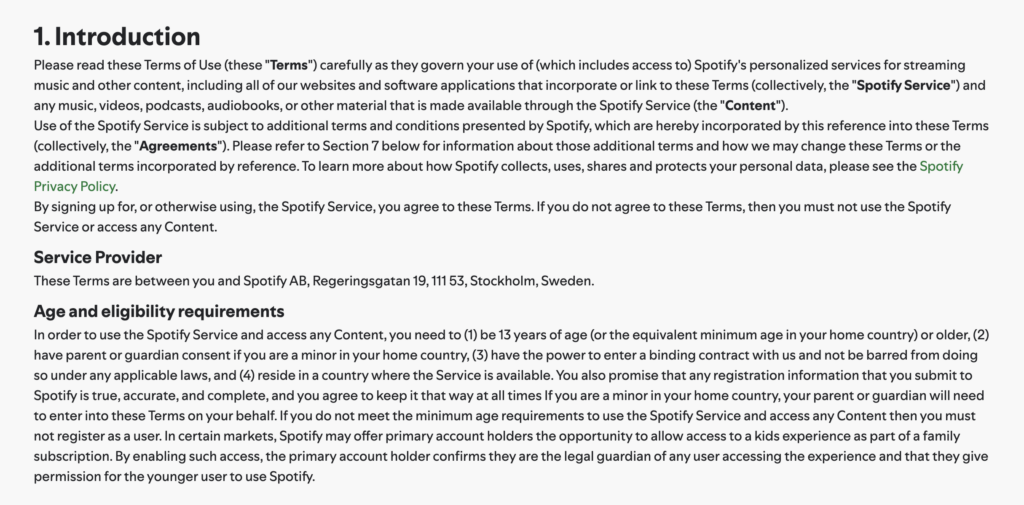
Spotify also includes minimum age/ eligibility requirements upfront.
Definitions
Since Terms and Conditions are legal documents, they often include words or phrases that may not be familiar to all users. To reduce confusion and avoid misinterpretation, include a definitions section that explains how certain terms are used within the document.
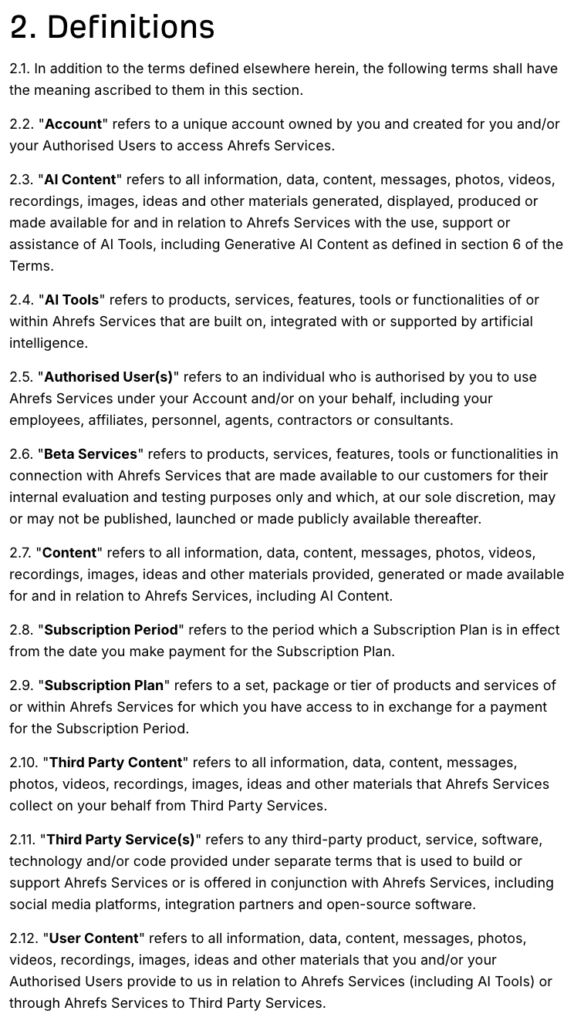
This section helps ensure that key words have a clear and consistent meaning throughout your Terms. Ahrefs shows how defining commonly used terms upfront can make the agreement easier to understand while reducing ambiguity.
Eligibility and age requirements
Once the scope of the agreement is clear, the next step is to define who can use your service. If your service is intended only for adults, specify the minimum age, such as 18 years old. Where minors are allowed, clarify that parental or guardian consent is required.
Age eligibility depends on local laws and may vary by country or region. In the EU, the digital age of consent is 16, though Member States may set it between 13 and 16.
Many large platforms handle this section in a straightforward way. For example, Facebook’s Terms and Conditions define who can create an account along with user responsibilities.
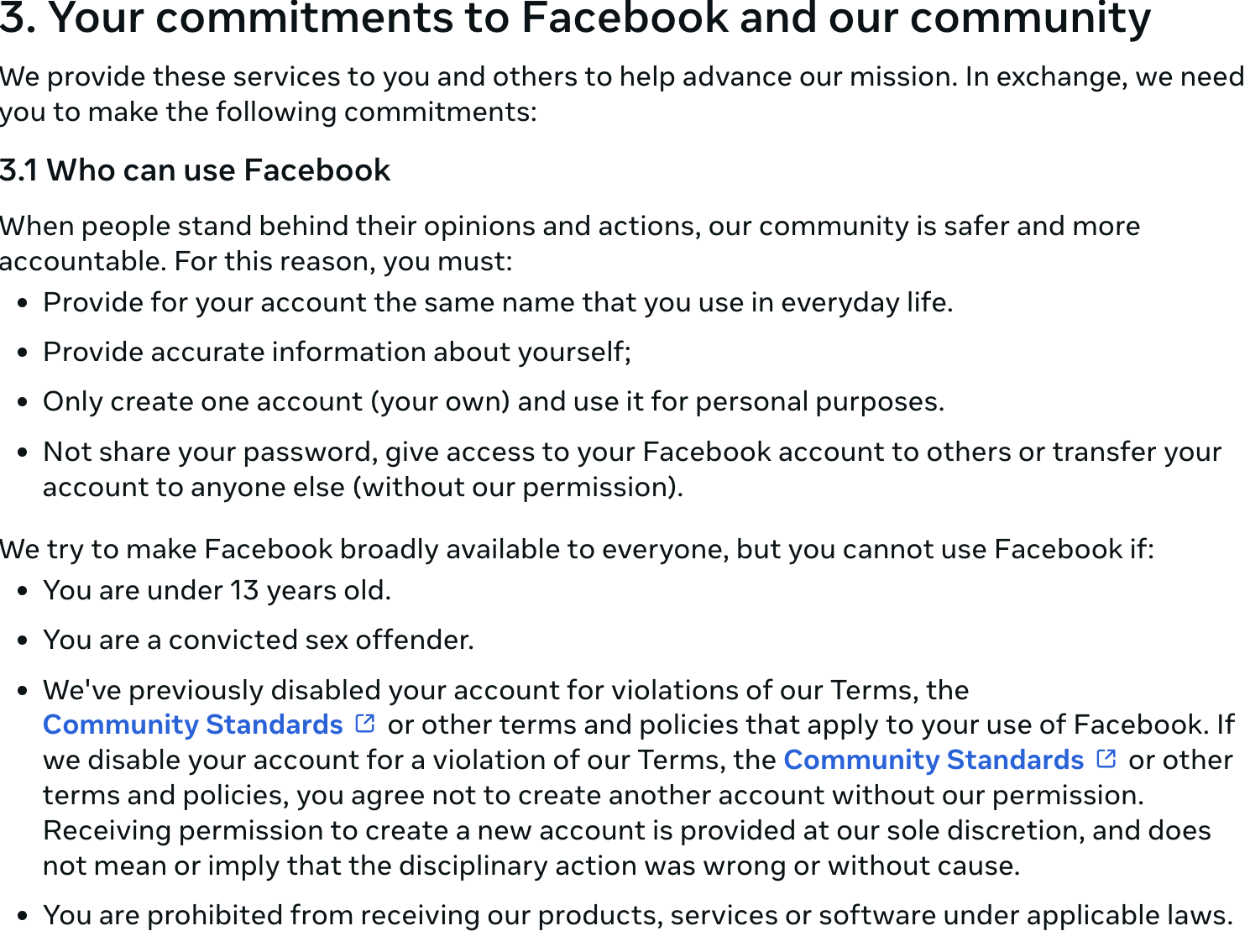
Facebook also clearly lists who cannot use the service. This includes users below the minimum age requirement, previously disabled account users, and those legally restricted from accessing the service.
By stating these conditions upfront, Facebook reduces misuse and sets enforceable boundaries for its community.
Permitted and prohibited use
This section explains how users may interact with your service and, just as importantly, what they must not do. You can outline permitted actions such as browsing, registering an account, or purchasing products, and then list prohibited behaviours.
Common examples include: spamming, hacking, malware, infringing intellectual property, unlawful content, harassing, or attempting to bypass security measures. Tailoring these rules to your industry helps remove ambiguity and sets clear boundaries.
Here is how Netflix T&C does this:
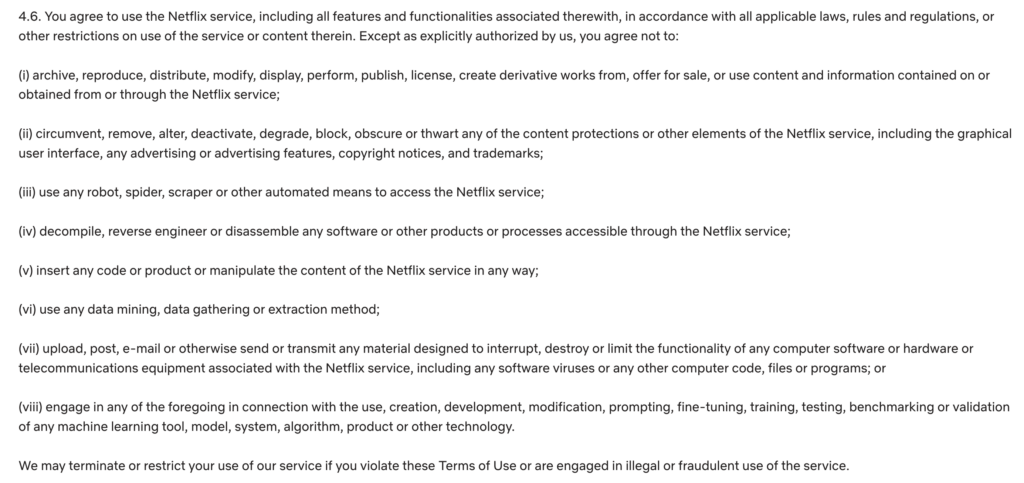
Clause 4.6 lists the restrictions. It explicitly prohibits actions such as copying or redistributing content, bypassing content protection measures and using automated tools. T&C also prohibits using the service for unlawful activities or misuse of emerging technologies, including automated systems and machine learning tools.
Account registration and security
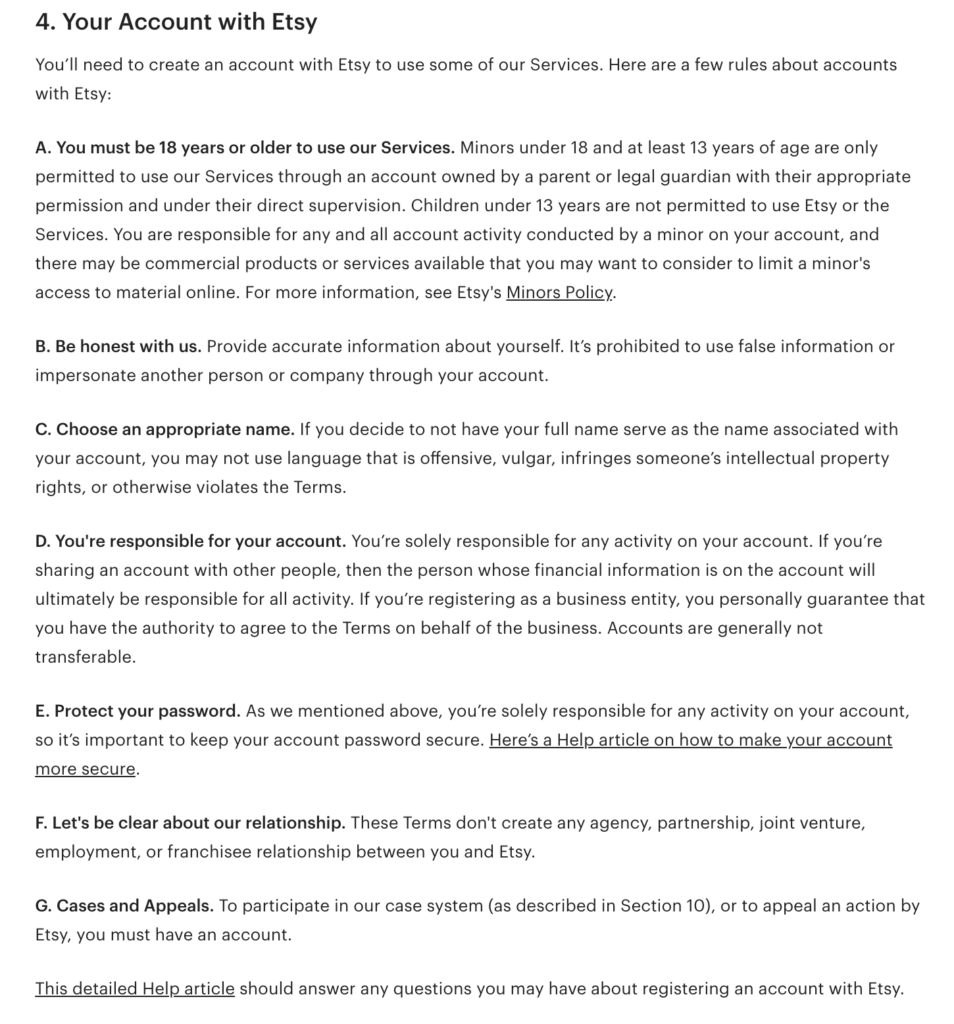
If users can create accounts, outline the registration process and their obligations. Mention that users must provide accurate and up‑to‑date information, keep passwords confidential and inform you promptly of any unauthorised access.
It’s also important to state that users are responsible for all activity conducted under their account. Here is an example from Etsy’s T&C.
Payment, pricing and subscription terms
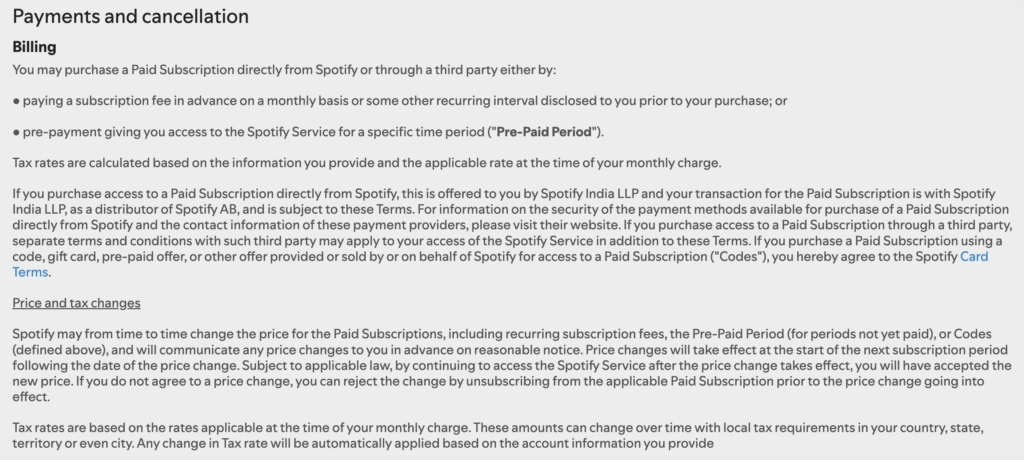
If you offer paid services or subscriptions, your terms of service template should specify accepted payment methods, pricing structures, billing intervals, tax obligations, auto‑renewal conditions, etc.
This includes how and when charges will appear, how to update payment details, and under what circumstances you may refuse or cancel orders.
Here, you should also outline procedures for renewing or cancelling subscriptions and note whether fees are refundable. Refer to this example from Spotify.
Here is another example from Birkenstock:
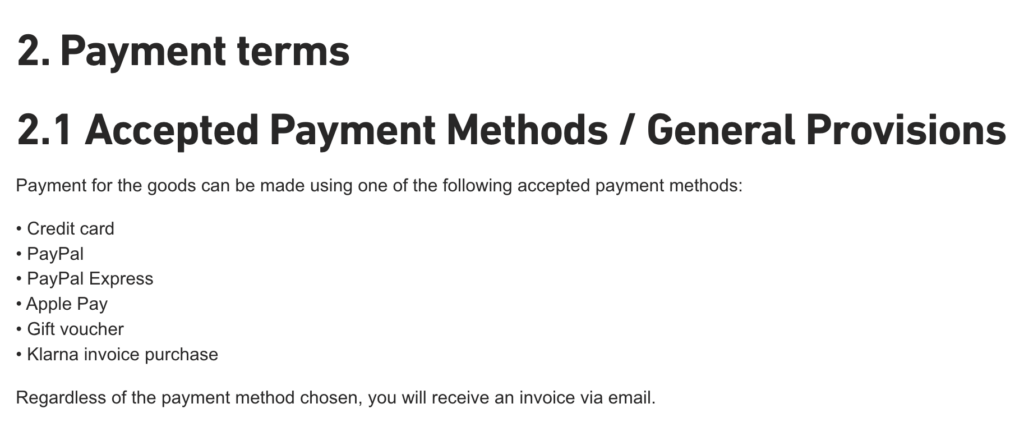
Remember: Your Terms and Conditions should reflect your specific business. Focus on transparency and clearly explain what users need to know, while keeping all terms fair and reasonable.
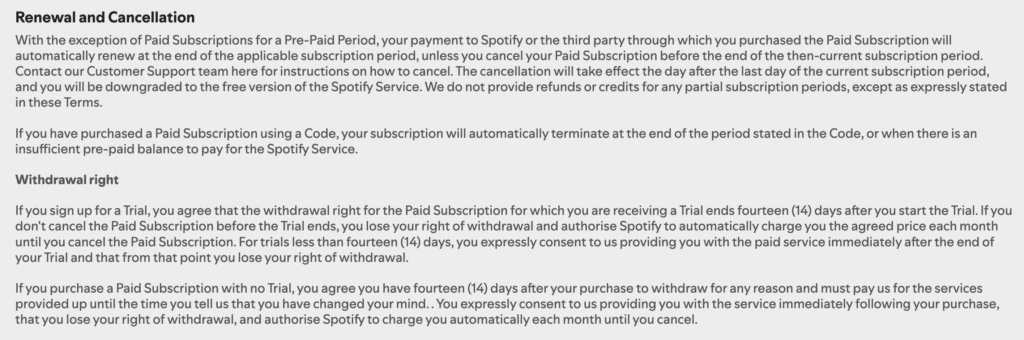
Returns, refunds and cancellations
This section of your T&C template summarises the refund and return policy, including any deadlines, conditions and exceptions. Distinguish between physical goods and digital services; for digital subscriptions, clarify if partial refunds or credits are available. Even if you maintain a separate refund policy page, referencing it here makes the information easier to find.
Intellectual property rights (IP rights)
Clarify that your site’s content including text, images, logos and design, is your property protected by copyright, trademark and other IP laws.
You may grant users a limited licence for personal, non‑commercial use and prohibit copying, modifying, or selling content without permission. Acknowledge that your trademarks and service marks are proprietary.
This T&C clause is typically supported by applicable IP laws, including copyright laws, trademark laws, and, where relevant, database protection and software protection laws.
Such laws vary by jurisdiction but generally protect original content, branding, and proprietary technology from unauthorised use.
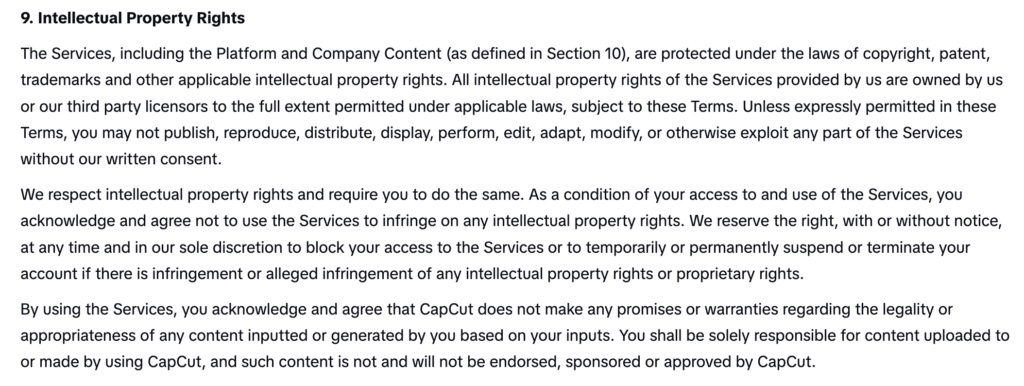
Here’s an example of how it is handled in practice.
CapCut’s T&C clearly state that all elements of the service, including the platform, software, design, and company-provided content, are protected by IP laws.
User‑generated content and licence
If you allow user submissions (comments, reviews, posts), define the rights and responsibilities associated with that content.
You may add that, by submitting content, users permit you to run and promote your service, for example, by displaying or sharing it within your platform. It’s also standard practice to reserve the right to review, edit, or remove user content if it violates your terms or applicable laws.
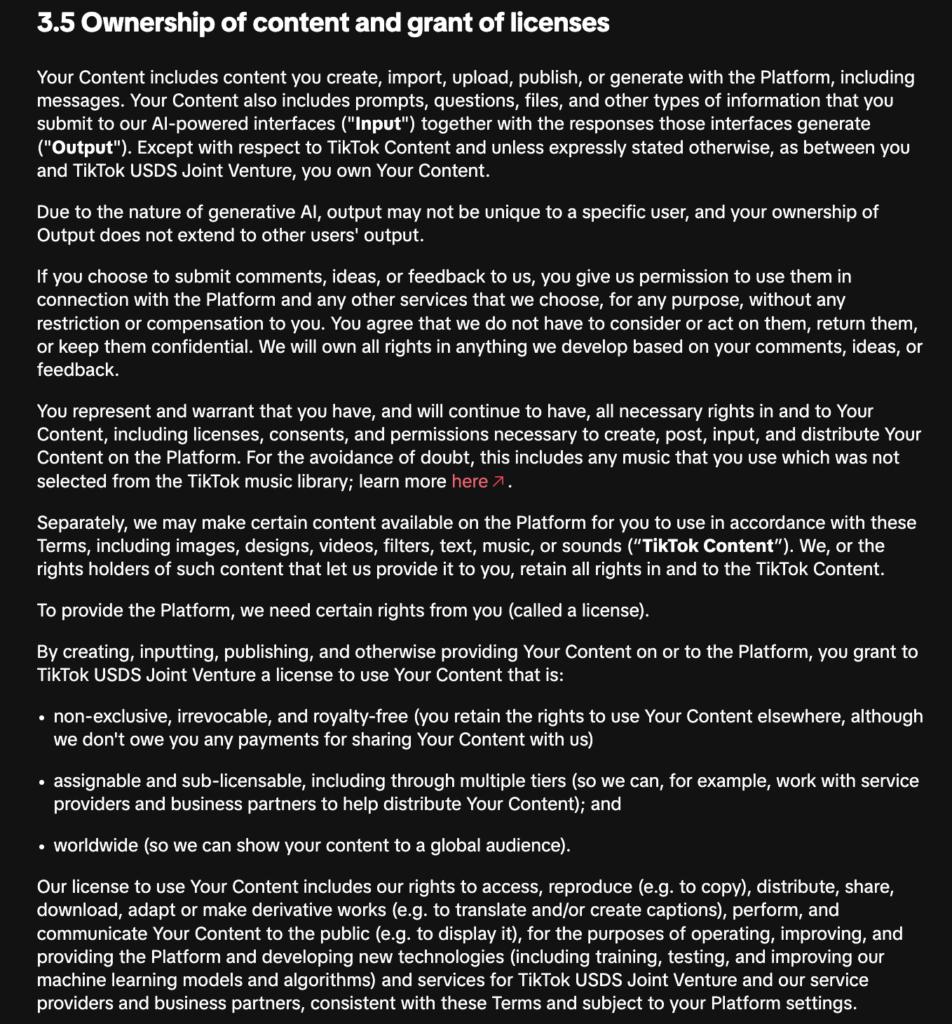
Checkout this example from Titkot T&C.
Third‑Party services and links
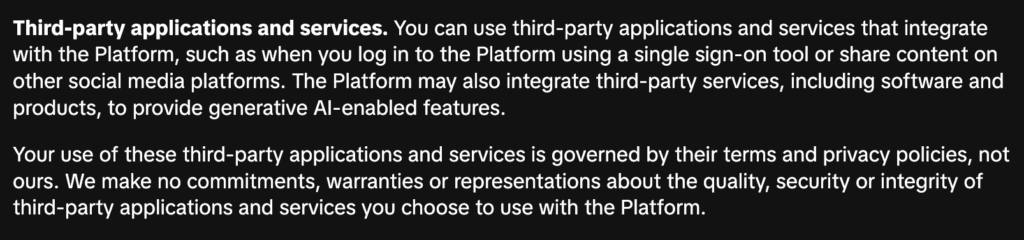
Note that your service may integrate payment processors, analytics tools or social logins and may link to external sites. It is also better to clarify that these third parties operate independently and have their own terms and privacy policies. You may advise users that they access third‑party services at their own risk and that you are not liable for any loss or damage arising from such use.
Here is another example from TikTok Terms and Conditions.
Privacy, cookies and data protection
Most data protection laws today expect websites to clearly explain how personal data is handled and how cookies are used. Instead of repeating all those details, it’s common to link T&Cs to Privacy Policy and Cookie Policy.
In your Terms and Conditions document, you can state that personal data is processed in line with your privacy and cookie policies. You can also mention that cookies or similar technologies are used to improve functionality, measure performance, and support marketing. Linking to these policies helps keep things clear and allows users to better understand how they can manage their preferences.
Here is how Spotify links its privacy policy along with other legal documents.

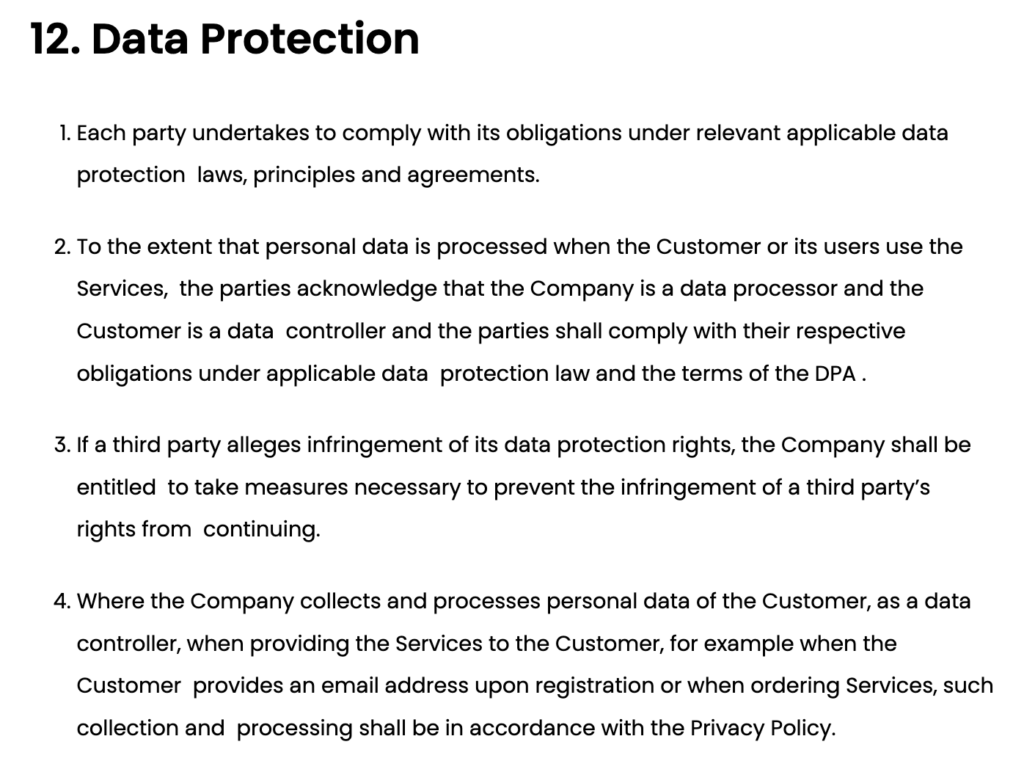
CookieYes T&C links its privacy policy in the introduction and then refers to it in the data protection clause (See 12.4).
Disclaimers and warranties
The disclaimer clause sets realistic expectations about how your service works and what users can reasonably rely on.
In simple terms, it explains that your service is provided “as is” and “as available,” without guaranteeing uninterrupted access or error-free performance. For websites that show user-generated or third-party content, this section also clarifies that you’re not responsible for the accuracy or reliability of that information.
The scope and wording of this clause can vary depending on the type of website you run. As with all sections of your Terms and Conditions, the key is to keep it aligned with how your service actually operates and what users should reasonably expect.
Below is an example from Amazon T&C:

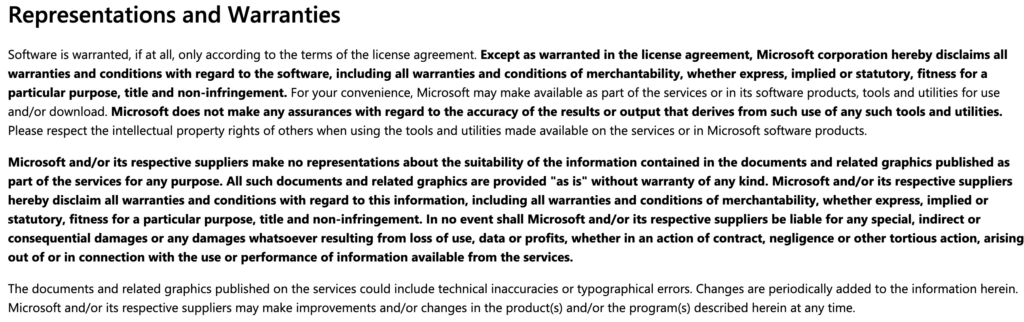
Here is another, more elaborate example from Microsoft T&C .
Limitation of liability
Another key clause of any T&C template is the limitation of liability clause. This is where you define how far your legal responsibility extends if something goes wrong while using your service.
In practice, it allows you to explain that your business is not responsible for indirect or unexpected losses, such as incidental or consequential damages. At the same time, it’s important to acknowledge that these limitations can’t apply in every situation. Some laws restrict how much liability can be excluded.
Below is Birkenstock’s Liability clause:
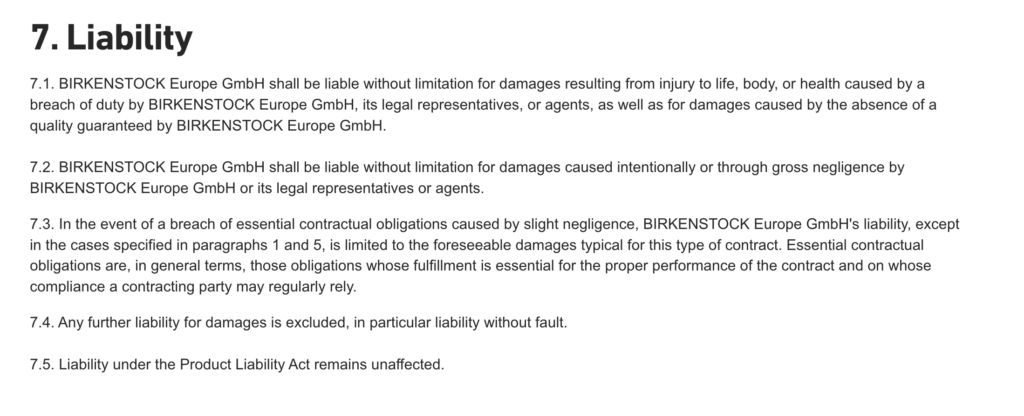
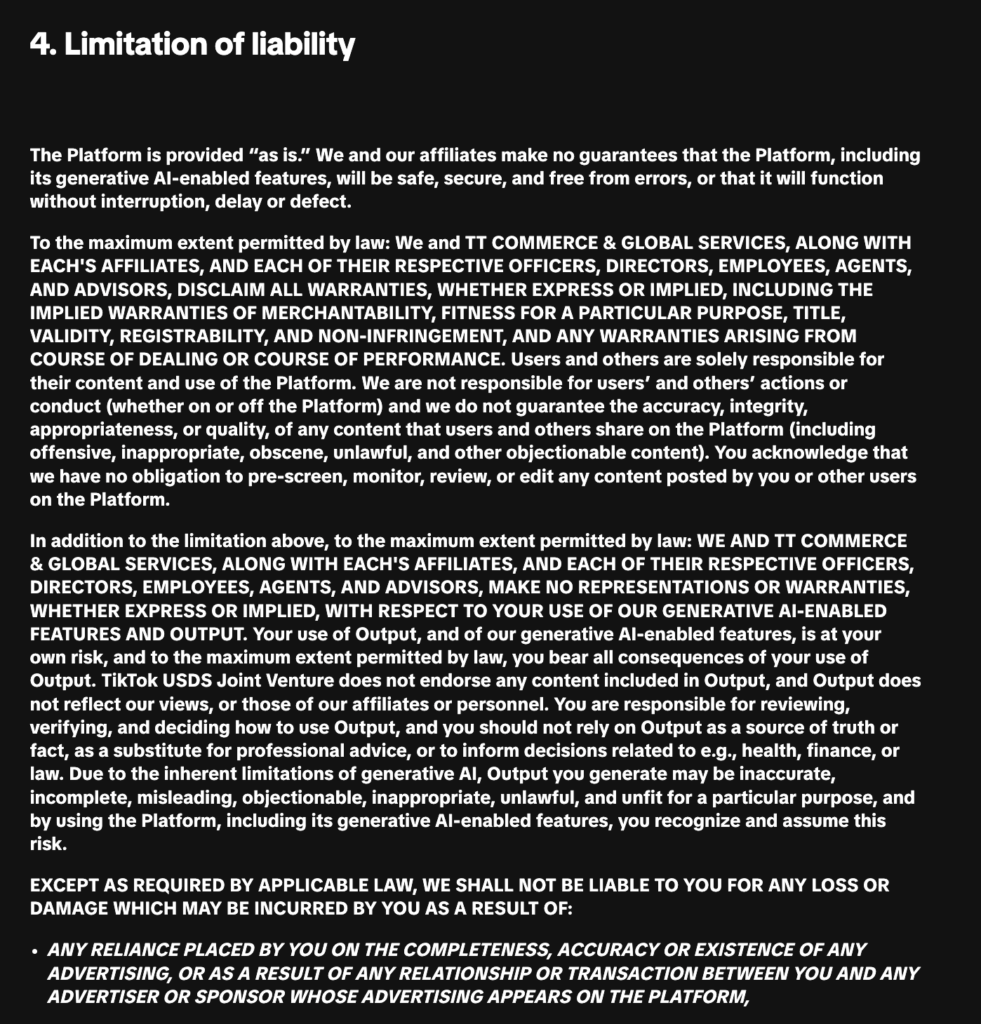
TikTok’s liability clause is more detailed and tailored to its business needs.
Indemnification
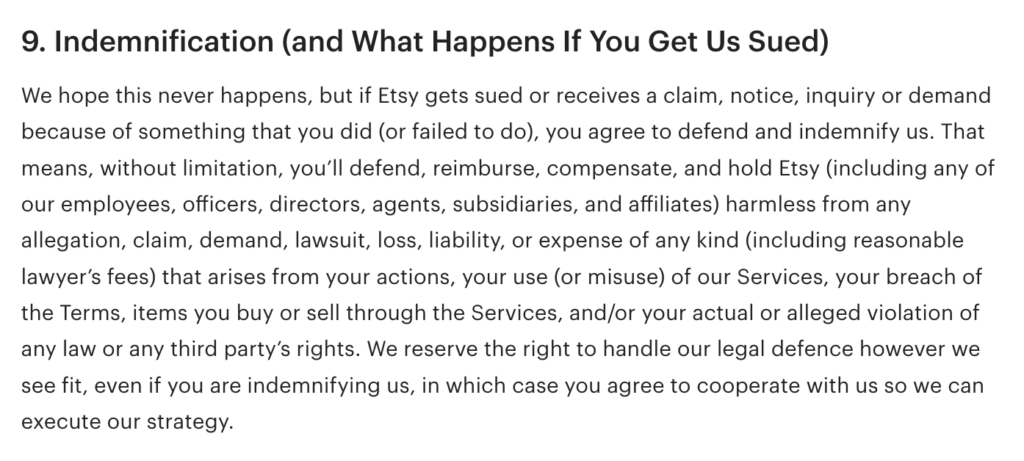
This is where you define when users are responsible for compensating your business for losses. It typically explains that users must cover claims, damages, or costs, including legal fees, that arise from their misuse of the service, violations of the Terms, or infringement of third-party rights.
The purpose of the indemnity clause is to ensure that liability rests with the user whose actions caused the harm, rather than with the platform itself.
See this example from Etsy’s T&C template:
Governing law and dispute resolution
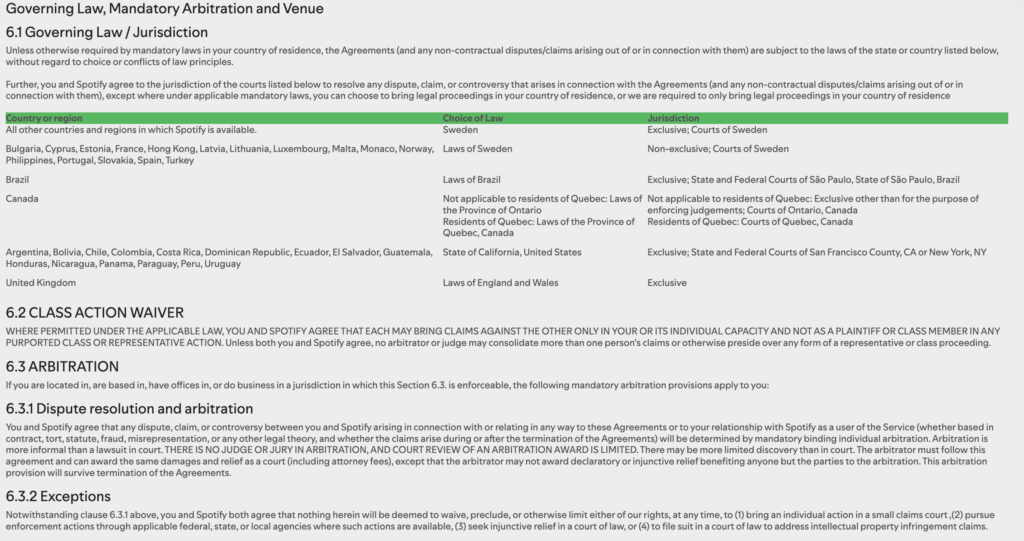
You should also specify which jurisdiction’s laws govern the agreement. This often includes whether disagreements must be resolved through local courts, arbitration, or mediation.
Some businesses also use this clause to address class-action waivers or set reasonable time limits for bringing claims, as long as these terms comply with applicable consumer protection laws and do not unfairly limit user rights.
The following example from Spotify Terms and Conditions shows how this can be typically structured in practice.
Modifications to Terms
Add a clause reserving the right to update your Terms and Conditions over time. This section typically explains that changes may be made when needed and describes how users will be informed of important updates, for example, through email notifications, notices on the website, or in-app messages.
Clause 13 of Etsy’s T&C presents this information this way:
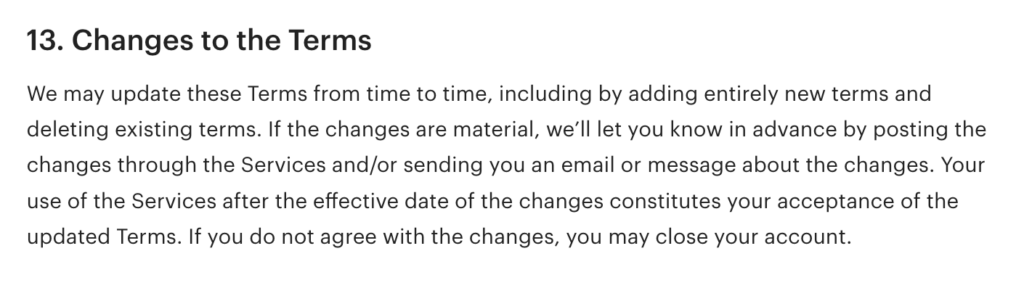
Display the Effective Date at the top of the document and maintain a record of previous versions (optional) so users can see what has changed.
Termination and suspension
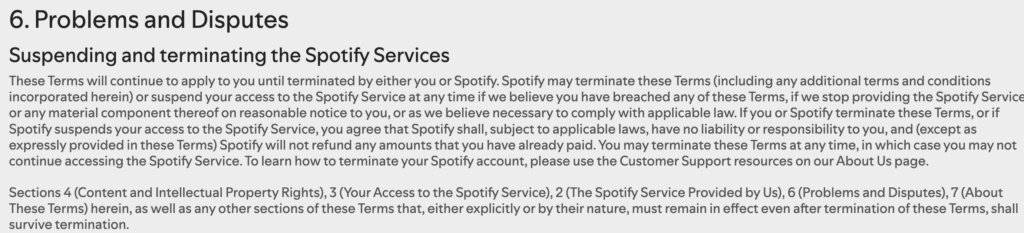
Set out the circumstances under which you may suspend or terminate user accounts. If you provide grace periods or warnings before termination, describe the process.
To see how this works in a real-world agreement, consider the following example from Spotify.
Severability and entire agreement
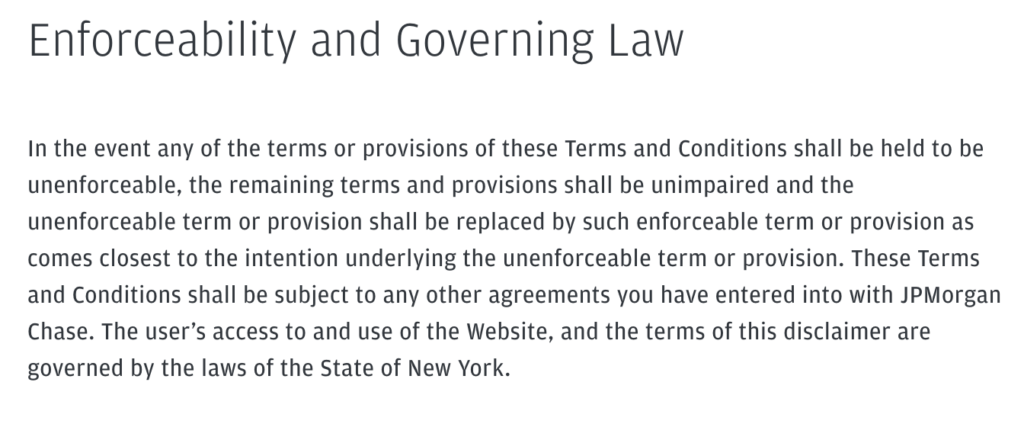
Include a severability clause stating that if any provision is deemed invalid or unenforceable, the remaining provisions remain in effect. Confirm that these terms constitute the entire agreement between you and the user concerning the service and supersede any prior agreements or communications.
Terms on JP Morgan is shown here as an example:
Assignment and transfer of rights
Indicate that you may assign or transfer your rights and obligations under the agreement in connection with a merger, acquisition or sale. State that users may not assign their rights or delegate their obligations without your prior written consent. This ensures continuity if ownership changes.
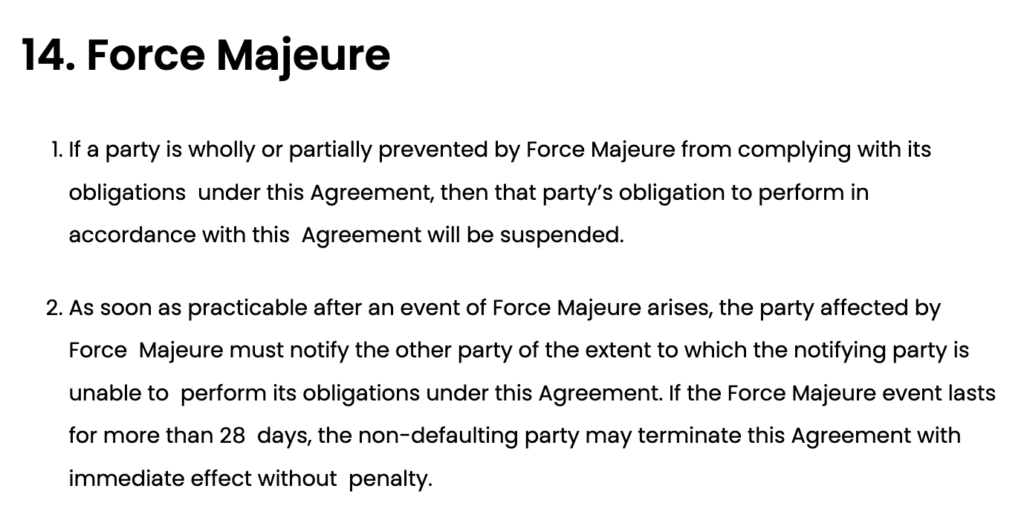
Force majeure
Define events beyond your control, such as natural disasters or war, that may prevent performance.
No waiver
Most Terms and Conditions include a clause to clarify that a delay or failure to enforce any part of the agreement does not amount to a waiver of that right. This helps prevent misunderstandings where a provision is not applied immediately or consistently.

No Agency or Partnership
Clarify that the agreement does not create a partnership, joint venture, employment or agency relationship between you and the user. Users do not have the authority to bind or represent your company, and vice versa. This clause is especially important for platforms that allow user‑generated content or peer‑to‑peer interactions, as it distinguishes the service provider from the actions of its users.
Look at this example from Etsy.

Feedback and submissions
If users provide feedback, ideas or suggestions about your service, you could specify how you handle those submissions. A typical clause states that users grant you a non‑exclusive, royalty‑free, perpetual and irrevocable licence to use, modify and incorporate their feedback without compensation.
Contact information
Conclude with a section explaining how users can contact you with questions, complaints or legal notices. Provide a support email, a mailing address and, if relevant, other communication channels. Note which method should be used for official notices and set expectations for response times if necessary.
How do I write my terms and conditions?
We understand that writing legal documents is not an easy task, but following a few best practices makes the process of writing a T&C manageable:
- Use clear, plain language: Avoid legal jargon. If users understand your terms, courts are more likely to enforce them.
- Reflect your brand voice: The tone of your T&C should match the tone of your website. An approachable, conversational style can reduce friction and build rapport with customers.
- Tailor the content to your business: Don’t copy another site’s terms. A generic template may miss critical details unique to your service or industry.
- Ensure visibility and consent: Link your T&C in your footer, sign‑up forms, checkout pages and any place where users interact with your service. Use browsewrap (implied by use) and clickwrap (a checkbox or button) methods to obtain consent.
- Review local laws: If you serve customers in multiple regions, account for e‑commerce rules, consumer protection statutes and privacy laws in those jurisdictions.
- Update regularly: Revise your terms whenever you introduce new features, adjust pricing, expand into new markets or when laws change. A review every 6–12 months is a good practice.
- Seek legal advice when needed: Especially if you operate in a regulated industry (e.g., finance, healthcare) or target minors, consult an attorney to ensure compliance with specific laws.
Where should you display your Terms and Conditions?
Your Terms and Conditions should be easy to find, easy to access, and available before a user takes any action that creates a legal relationship with your business.
- Place in the website footer, alongside links to the privacy policy and cookie policy.
- If your site involves account creation, subscriptions, payments, or downloads, it should also be linked directly at the point of sign-up or checkout.
- For SaaS platforms and apps, surface the Terms during onboarding, trial activation, or subscription upgrades before accessing paid features.
- Mobile apps usually include the Terms within the app store listing and inside the app’s settings or legal section.
The key principle is consistency: users should be able to access your Terms before agreeing to them, and again later if they want to review what they accepted. Hiding Terms behind multiple clicks or placing them only after a transaction increases legal risk and weakens enforceability.
What are examples of Terms and Conditions? (Terms of Service examples)
Here are some more real-life examples of Terms and Conditions:
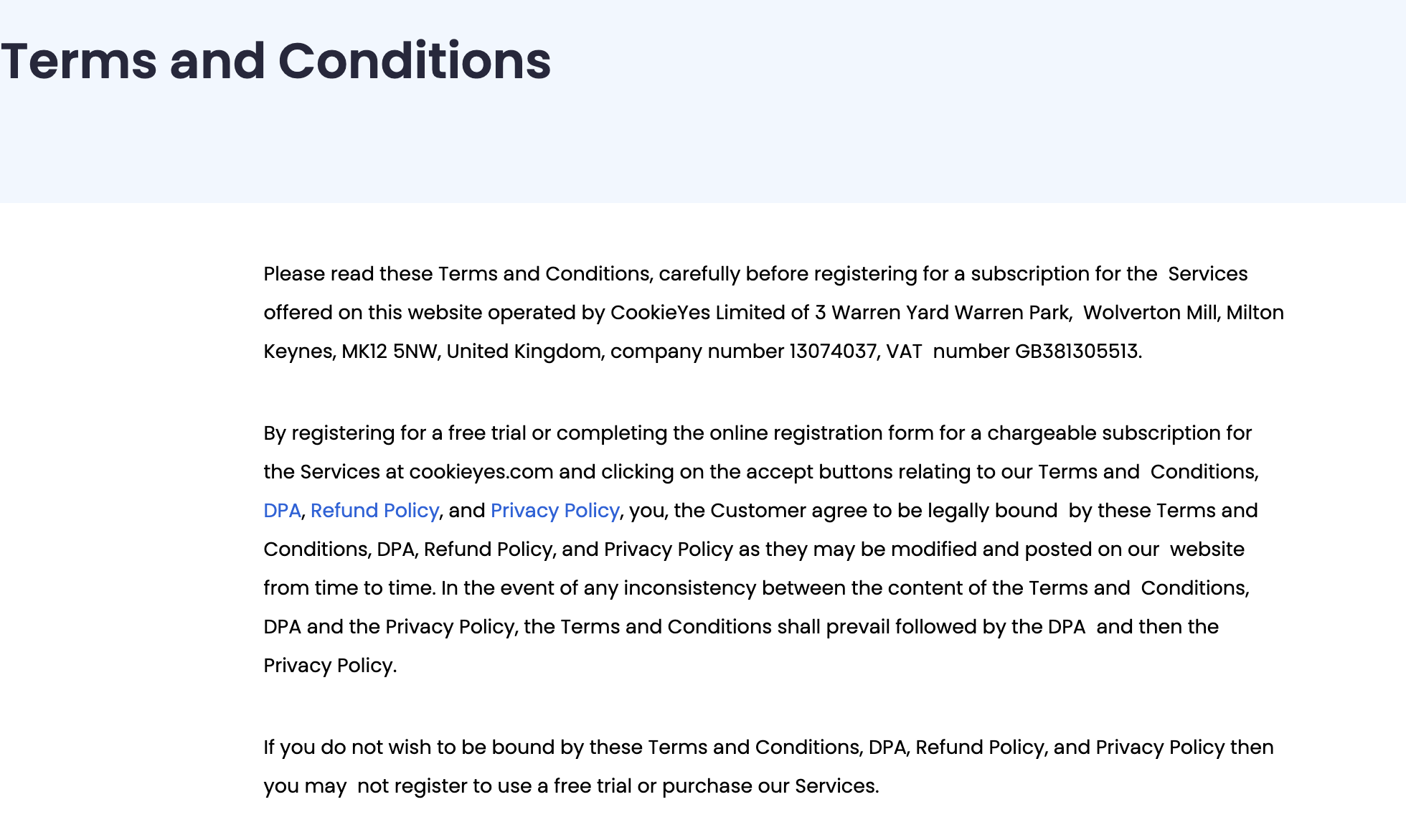
CookieYes Terms and Conditions
The CookieYes T&C document sets out a comprehensive contractual framework for using our subscription-based services. It covers core elements such as service scope and availability, licensing rights and restrictions, intellectual property ownership, fees and billing, trial-to-paid conversion, termination rights, and limitation of liability.
It also has clauses on data protection (with a linked DPA), confidentiality, warranties, indemnities, force majeure, and governing law, along with clear definitions and consent hierarchy across related policies.
AirBnb
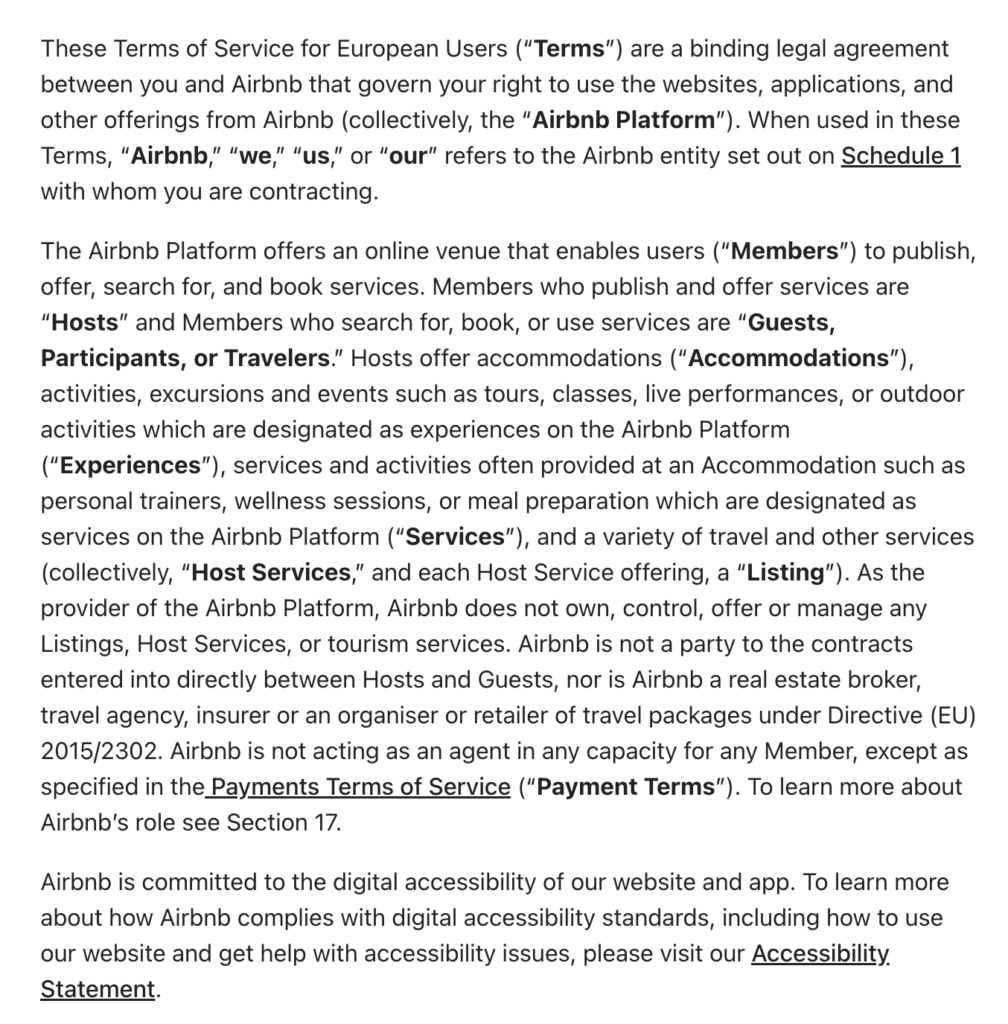
Airbnb’s Terms and Conditions govern the use of its platform by guests, hosts, and users, outlining account registration, booking and payment processes, cancellations and refunds, user conduct, and platform rules.
The terms include detailed liability limitations, indemnity obligations, dispute resolution mechanisms (including arbitration and class action waivers in certain regions), intellectual property rights, and content usage rights. They also address trust and safety, host and guest responsibilities, and jurisdiction-specific provisions to reflect Airbnb’s global operations.
Apple
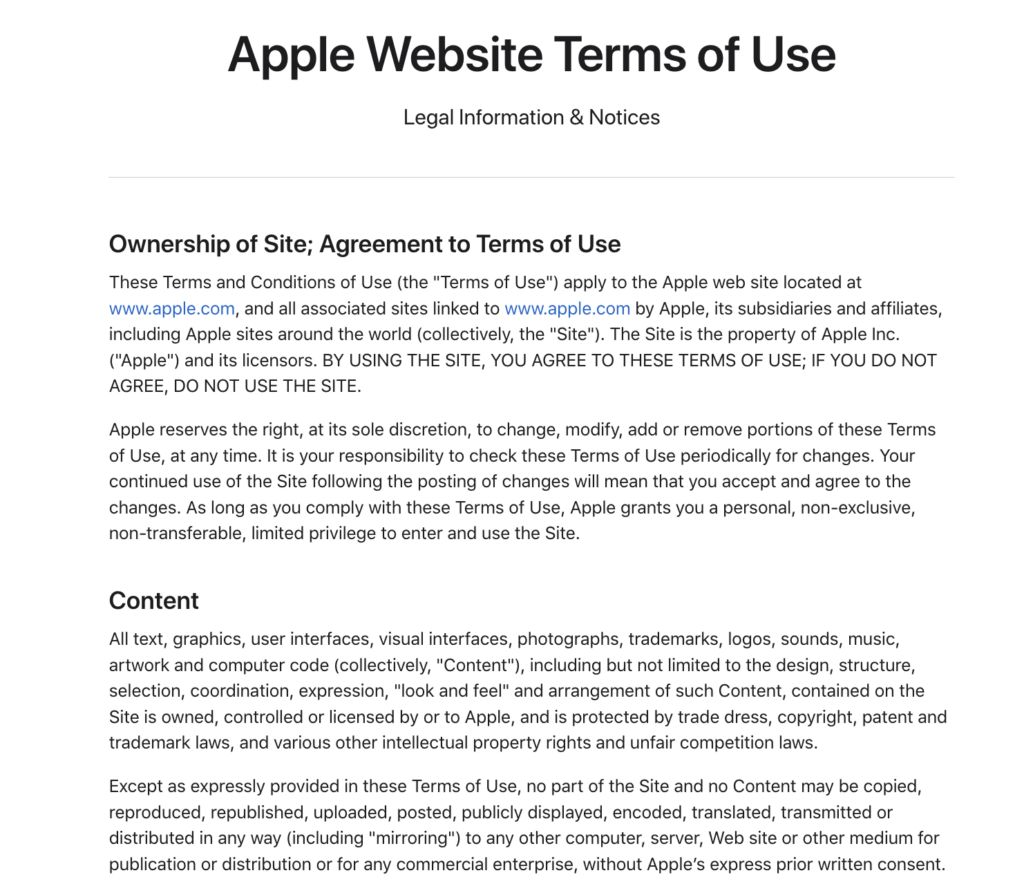
Apple’s Website T&C govern how visitors may access and use apple.com and its related regional sites. They focus heavily on intellectual property ownership and permitted use of site content.
The terms also address account security for site features, links to third-party sites, broad warranty disclaimers, limitation of liability, and an indemnity clause for claims arising from a user’s actions.
How to make your Terms and Conditions enforceable?
A Terms and Conditions page protects you best when users can’t say they never saw it.
Here’s what works:
- Put it in your website footer
- Add it to signup forms and checkout pages with a checkbox for clickwrap consent
- Use clickwrap over browsewrap consent
- Keep language clear without unnecessary jargon
- Ensure reasonableness and fairness
FAQ on terms and conditions template
T&C stands for Terms and Conditions, which is shorthand for the agreement that sets out the rules of engagement between a service provider and its users. This abbreviation is often used interchangeably with ToS and ToU.
A privacy policy explains how a website collects, uses, stores, and shares personal data, and is required under privacy laws like the GDPR and CCPA.
Terms and Conditions set the legal rules for using the website or service, covering user responsibilities, payments, intellectual property, and liability. In short, the privacy policy focuses on data protection, while terms and conditions govern how users may use the service.
Yes, Terms and Conditions can limit liability, but only within what the law allows. Most T&Cs include clauses that cap financial liability, exclude indirect or consequential damages, and define circumstances where the business is not responsible.
However, liability limits cannot override mandatory consumer protection laws in many countries, and exclusions for fraud, gross negligence, or personal injury are usually not enforceable.
Terms and Conditions are not legally required, but they are strongly recommended. While laws like the GDPR or CCPA mandate a privacy policy, T&Cs help set clear rules for using your website or service, limit liability, and manage disputes.
In practice, many platforms, app stores, and payment providers require Terms and Conditions to protect both the business and users.
Yes, Terms and Conditions could be legally binding if users are given clear notice and actively agree to them, such as by clicking an “I agree” checkbox during sign-up or checkout. Enforceability also depends on other factors including local consumer laws, circumstances, fairness, etc.
Courts generally enforce T&Cs when they are accessible, written clearly, and not unfair or misleading. If terms are hidden, unclear, or never accepted, their enforceability can be challenged.
Yes, you can write your own Terms and Conditions. You can create them from scratch or use a Terms and Conditions template that suits your website.
What matters most is tailoring the Terms and Conditions to how your website actually works. Generic text, whether taken from templates or generated using AI tools, may not accurately reflect your business model or user interactions. If possible, have your Terms and Conditions reviewed by a legal professional.
Otherwise, you can go for a Terms and Conditions generator. Once prepared, your Terms and Conditions should be placed in the website footer and clearly linked during sign-up, checkout, or any point where users agree to use your services.

Safna is the resident data privacy writer at CookieYes, where she breaks down privacy laws into actionable insights for businesses. The rest of her time is a mix of music, movies, and hot chocolate.